
Brand awareness is not an attribution model. If you're going into a B2B event hoping "brand awareness" is the ROI you'll report back to your CRO, you're already in trouble. Unless you have an unlimited budget, every event needs to answer a harder question: what pipeline did this actually produce.
I've spent the last seven or eight years running growth and demand marketing for B2B companies in Ireland, working across events all over Europe — from small niche exhibitions to major conferences. In that time I've run the full spectrum: exhibiting with a booth, speaking on stage, attending without a stand, and skipping events entirely while still working the room from a distance. Each one demands a different playbook. Most B2B teams only have one playbook — the booth one — and apply it badly even then.
Here's the framework I use, split into three scenarios, plus the one rule that determines whether any of it works.
The 40-20-40 rule
Setting up a booth and having someone stand behind it is the easy part. It's also the least important part.
The work that actually produces ROI splits roughly like this: 40% pre-event, 20% on-site, 40% post-event. Most teams invert this. They pour budget and energy into booth design, banners, and swag, then show up, hope for the best, and let leads go cold in a spreadsheet for three weeks after. If you're not deliberately protecting the 80% of effort that sits outside the event itself, you won't see attribution — no matter how good your stand looks.
Everything below assumes you're respecting that split.
Scenario 1: You're all in — exhibiting or speaking
This is the highest-commitment, highest-cost option, so it needs to start earning its budget one to two months before the event, not on the day.
Get your AEs activated early. Once you're confirmed as an exhibitor or speaker, you'll usually get access to an attendee list — at minimum, the companies attending, plus other exhibitors. Cross-reference that against your ICP and build a target list. Then activate your account executives to start LinkedIn outreach before anyone's set foot in the venue.
The outreach itself benefits from automation. Tools like Sales Navigator combined with outreach automation tools (we used PhantomBuster) let AEs run this at scale, and it's worth pulling senior leadership into the same motion — a CRO or CXO reaching out gets more replies than an AE cold message. The message itself matters more than the tooling, though: this is not a sales pitch. It's "I noticed your company's attending — are you going too?" and nothing more. You're opening a conversation, not closing a deal. Selling too early kills the reply rate.
A side note on automation: LinkedIn doesn't love tools like PhantomBuster or automated Sales Navigator scraping — it's a grey area against their terms of service, and accounts can get flagged or restricted for it. If you go this route, treat it as a calculated risk, keep the volume and pace realistic rather than aggressive, and have a manual fallback ready. Worth a conversation with whoever owns compliance risk on your team before you scale it up.
Build content around the event. People search for the events they're attending. If your brand or logo shows up when they do, that's a small but real win — and it compounds with paid: we'd typically run Google Ads alongside organic content aimed at the same searches. If you have a booth, look for a PR angle — an announcement timed to the event — to build a bit of momentum before doors open. The goal across all of this pre-event content is visibility both in traditional search and increasingly in AI search, where event-related queries are showing up more and more.
Create a LinkedIn Event. This is the single most underused tactic I've seen in B2B event marketing. Set up a LinkedIn Event for your presence — booth, talk, or both — and have your AEs and leadership team invite relevant people from their own networks. You can filter and semi-automate who gets invited rather than blasting your entire network. Used well, it turns the event into a hook for engaging your existing LinkedIn audience, not just a logistics page nobody visits.
Go live during the event — but make it about them, not you. The 20% on-site slice of the 40-20-40 rule isn't just about staffing the stand. It's where you can win extra visibility with almost no extra cost: LinkedIn Live or short live video from the event itself. This works with a booth and works just as well without one — if you're not exhibiting, you can still go live from the show floor or a hallway.
The tactic that actually moves the needle isn't "go live and talk about your product." It's reaching out to prospects (and speakers — this is a good way to get in front of them too) beforehand and asking to interview them on camera for 10–15 minutes during the event. Frame it as a conversation, not a sales moment — you're capturing their perspective on the event, their industry, whatever's genuinely interesting to them. All you need is a phone camera and a decent clip-on or handheld microphone. It builds a real relationship in a way a booth chat never does, gives you content you can reuse for weeks afterward, and gets you five to fifteen minutes of undivided attention from someone who'd otherwise give you ninety seconds at a stand.
Do those four things properly and the booth stops being the centrepiece — it becomes the pickup point for conversations that already started weeks earlier.
Scenario 2: You're attending, not exhibiting
No booth, no stage time, but you're in the room. This is where a bit of growth hacking earns its keep.
The pre-event outreach from Scenario 1 still applies — LinkedIn Events, targeted AE outreach, "are you going too?" messaging — none of that requires a booth to justify it.
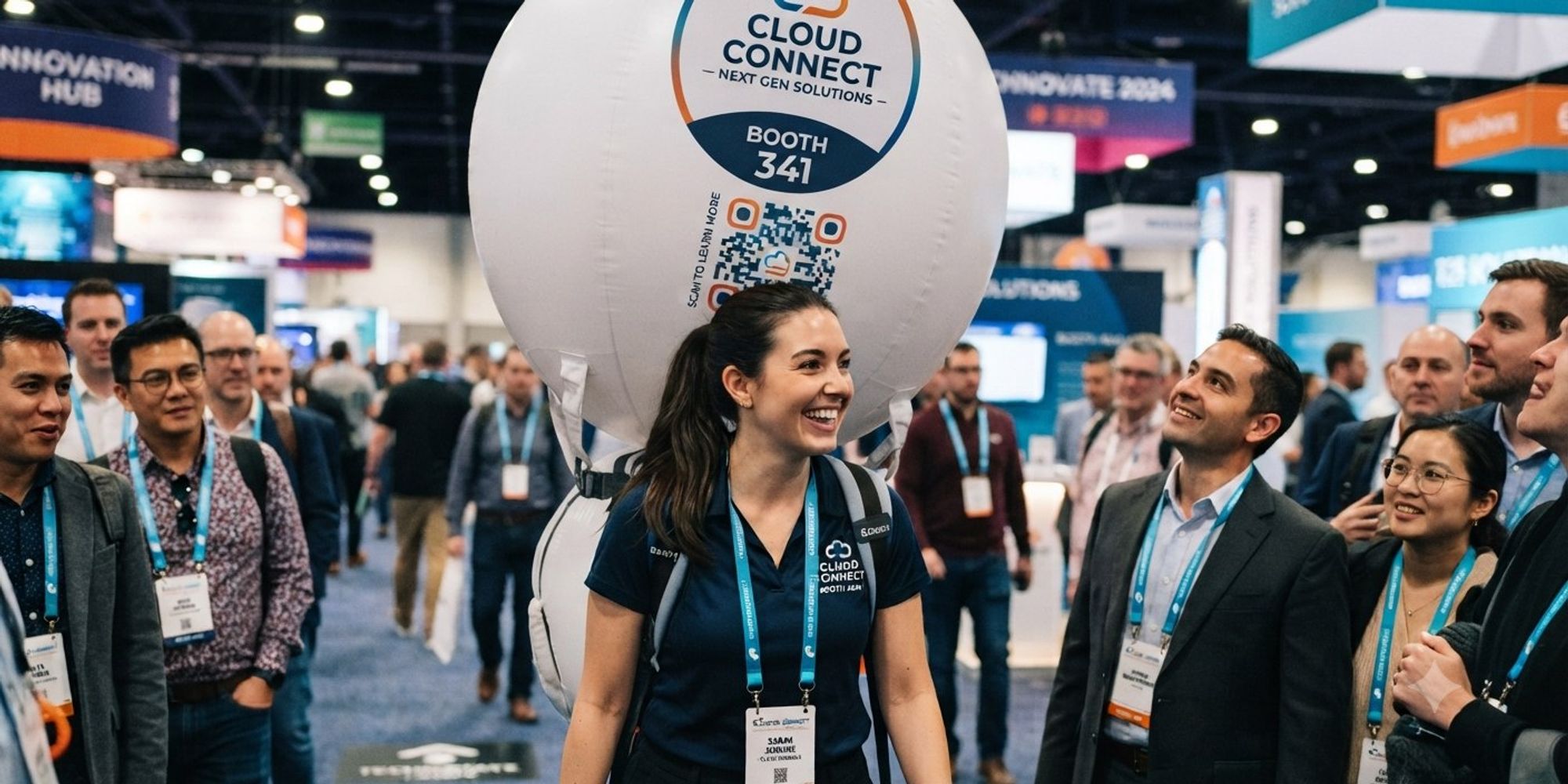
Where this scenario gets more creative is on-site. One tactic that worked well for us: we hired two people to work the floor as walking activations — one carrying an LED backpack, the other a signage backpack with an inflated balloon carrying our messaging, moving through the crowd rather than sitting still at a stand. They handed out flyers directing people to scan a QR code for a small giveaway — a coffee voucher, an Amazon voucher — in exchange for answering one or two qualifying questions. It's a genuine growth hack, and worth knowing that some event organizers don't love unofficial activations on their floor, so read the room and the rules before you commit to it. But it converts foot traffic into a real database in a way that just being present in the crowd never will.
The on-camera interview tactic from Scenario 1 also works well here — arguably better, since you're not tied to a stand. Reach out to prospects and speakers ahead of time, ask for 10–15 minutes on camera during the event, and go live or record for later. No booth required, just a phone and a microphone.
The point of this scenario is that "not exhibiting" doesn't mean "not visible." You can build presence and collect leads without the cost of a stand.
Scenario 3: You're not attending at all
Even sitting this one out entirely, there's ROI on the table if you're willing to work from outside the room.
Find out who's attending. If the organizers have set up a LinkedIn Event, the attendee list is often visible there. Failing that, you can pull attendee, speaker, and exhibitor information from the event website and LinkedIn directly. Build your target list the same way you would if you were exhibiting, then run the same style of outreach — but the framing matters even more here, because you have no stand or talk to point to as a reason for the conversation. "I'm thinking of attending, saw you're going — what's drawing you to it?" works. A pitch does not. People go to these events for networking, not to be sold to on the way in, and outreach that respects that gets replies; outreach that doesn't gets ignored.
This scenario is essentially proof that event ROI isn't really about the event — it's about who's in the room, and you can reach most of "who's in the room" from outside it.
Events in a Box: the tactic that works in all three scenarios
This one's inspired by something LinkedIn used to run internally called "Events in a Box" — and it's the single tactic I'd recommend regardless of which of the three scenarios above you're in.
The idea: you equip your AEs (or a small sales pod) with a self-contained kit — a modest budget, a simple plan, and a bit of team support — to run their own side event alongside the main one. Not instead of the main event. Next to it. Different time, different venue, same city, same week.
What's actually in the box:
- A fixed, small budget (think: a private room, coffee and pastries, or drinks for 15–20 people — this doesn't need to be expensive)
- A simple invite template and a target list of 10–20 named prospects
- A format decision: casual (coffee morning, informal drinks) or structured (a small roundtable with a discussion topic)
- A clear owner — one AE or team member accountable for running it start to finish
Why it works: you don't need the whole floor. You need ten to twenty of the right people in a room where they can actually talk to you. A side event is small enough to be genuinely personal — you're not competing with a loud show floor or fighting for ninety seconds of someone's attention at a booth. It's also flexible on tone: a relaxed after-hours drinks event tends to pull people in more easily and unwind the "am I being sold to" guard, while a smaller structured roundtable works better for a more senior, serious audience. Match the format to who you're inviting.
And critically — this works even if you're not attending the main event at all. You don't need a badge, a booth, or a speaking slot to justify a side event. If a wave of your ICP is flying into a city for a conference, you can host something nearby that week and invite them into it, entirely outside the event's own footprint and without paying the event organizer a cent. This is arguably the highest-ROI version of the tactic, because your only cost is the room and the coffee — there's no exhibitor fee sitting underneath it.
Practically, this slots into the same pre-event motion described in Scenario 1: once your AE outreach identifies who's attending and gets a reply, the side event is the natural next step in that conversation — "we're actually doing a small coffee session Thursday morning near the venue, want to swing by?" It converts a LinkedIn reply into a real-world touchpoint without needing the main event to do any of the work.
The common thread
Across all three scenarios, the same three things determine whether you get attribution:
- Multi-stakeholder targeting, not single-contact outreach. B2B buying decisions involve several people. Reaching one contact per target account and calling it done leaves most of the value on the table.
- Networking framing, not sales framing, in every piece of pre-event and on-site outreach. The moment a message reads as a pitch, engagement drops.
- Front-loaded effort. The 40-20-40 split holds regardless of which scenario you're in — the booth (or the badge, or the absence of either) is the smallest part of the work.
Brand awareness might be a pleasant side effect. It was never the point. If you're going to spend the time or the budget, go in with a plan for which of these three scenarios you're actually running — and work it like one.
Where should you start?
Before your next event lands on the calendar, answer one question: are you exhibiting or speaking, attending without a booth, or not attending at all?
- Exhibiting or speaking → Start with AE activation and a LinkedIn Event. Get your target list built and outreach running one to two months out, before you touch booth design. Line up two or three on-camera interviews for the event itself.
- Attending, no booth → Start with the same pre-event outreach, then decide if an on-site activation (like the walking-backpack tactic or on-camera interviews) fits your budget and the organizer's rules.
- Not attending → Start with an Events in a Box side event. This is the scenario where it earns the most — you get the room full of the right people without paying for a badge, a stand, or a stage.
Whichever bucket you're in, Events in a Box is worth testing regardless — it's the lowest-cost, highest-personalisation tactic of the three, and it works whether or not you're anywhere near the main event's official footprint.
FAQ
What is B2B event marketing ROI?
It's the pipeline and revenue impact an event produces, measured against what it cost to attend, exhibit, or run activity around it — not brand impressions or booth traffic alone.
Is a trade show booth still worth it for B2B companies?
Only if the 40-20-40 split is respected: 40% pre-event outreach, 20% on-site execution, 40% post-event follow-up. A booth with no pre- or post-event work around it rarely produces attribution that holds up.
What is Events in a Box?
A self-contained kit — budget, invite list, format, and an owner — that equips an AE or sales team to run a small side event (10–20 people) near a larger conference, either alongside their own attendance or as a standalone alternative to attending at all.
Can you get B2B event ROI without attending the event?
Yes. Targeted LinkedIn outreach to confirmed attendees, combined with a side event such as Events in a Box, can generate qualified conversations with a conference's audience without paying for a badge, booth, or speaking slot.
How far in advance should B2B event outreach start?
One to two months before the event, once an attendee or exhibitor list is available, giving AEs time to research, reach out, and book conversations before the event itself begins.
Is LinkedIn automation safe to use for event outreach?
It's a grey area against LinkedIn's terms of service, and accounts can be flagged or restricted for automated scraping or outreach at scale. It's worth treating as a calculated risk, keeping volume realistic, and having a manual fallback in place.
What's an effective way to get more visibility from a B2B event without a big budget?
Recording short on-camera interviews with prospects or speakers during the event — 10 to 15 minutes each, arranged beforehand via LinkedIn — needs only a phone and a microphone, builds real relationships, and produces content that outlasts the event itself.
If you're building out a B2B event strategy and want a second opinion on the plan, get in touch →

Leave a comment.
Enter your email and your comment — comments are moderated before anything is published.
Comments are moderated. Your email is never published.
Thanks — your comment is in for review.
No comments yet — be the first.