
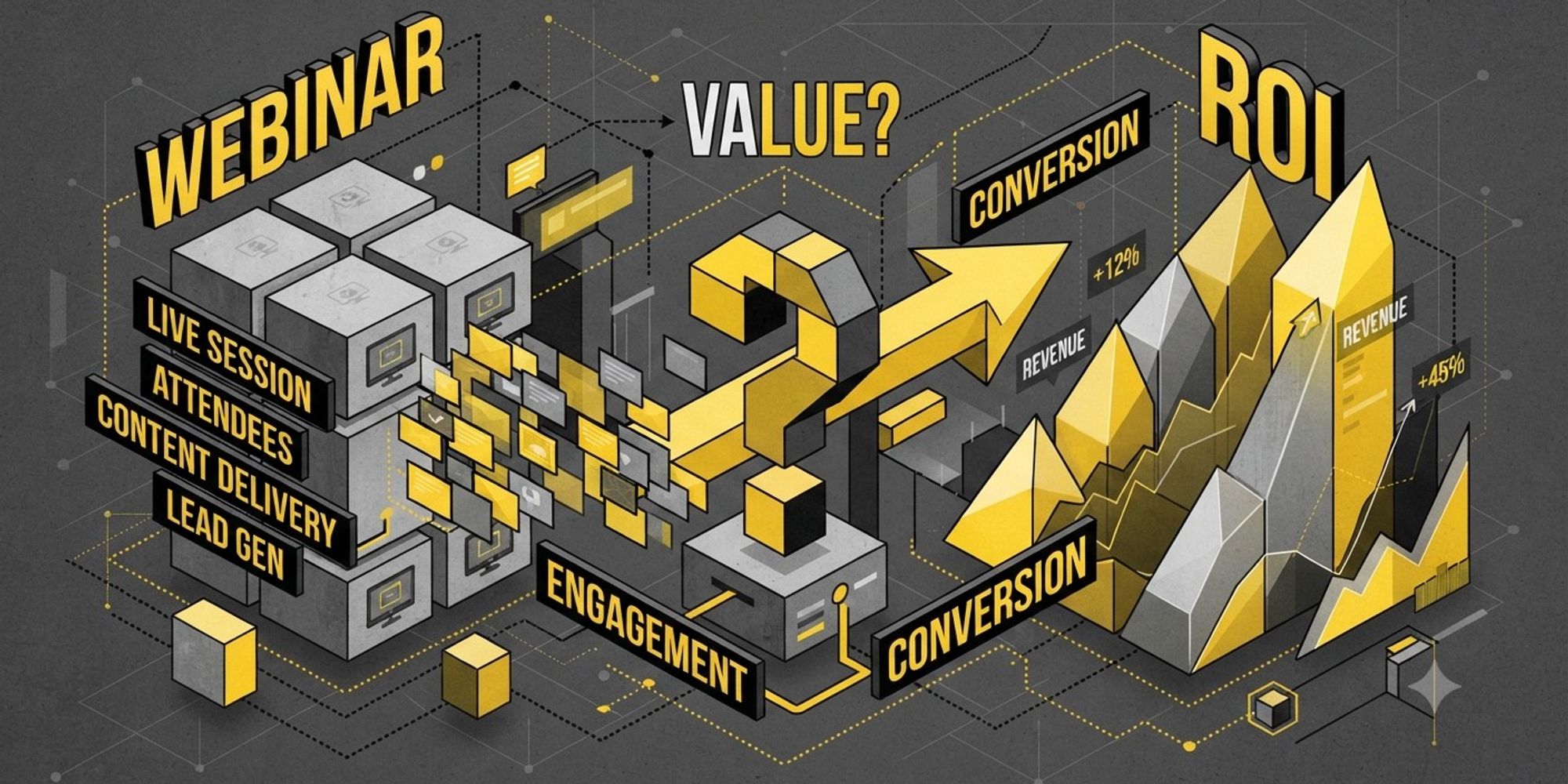
Attendance is collapsing. Depending on which benchmark report you read, live attendance now sits somewhere around 30% of registrants, down from well over half a decade ago. If you're running a webinar program and watching that number, it's tempting to treat it as a failure.
It isn't. Targeting 30% attendance is fine. It's the current reality of the channel, not a sign your program is broken — and chasing a bigger number by broadening your topic or your target list usually makes the pipeline worse, not better. The mistake isn't a 30% attendance rate. It's still measuring webinars as if attendance is the point.
Here's the reframe I'd argue for, based on running webinar programs across several B2B companies over the last few years: webinars have moved past being a lead-generation funnel. They're still one of the cheapest channels for cost per lead — that part hasn't changed. But their bigger value now is as a nurture and engagement engine: a way to move prospects who are already somewhere in your pipeline further toward sales-ready, rather than a tool purely for filling the top of the funnel.
That shift changes what you should actually build. Two formats do the heaviest lifting.
1. Smaller, live webinars — and stop obsessing over watch time
Narrower, live-only sessions consistently outperform big broadcast webinars on engagement, even with a fraction of the registrations. A tightly-targeted session with real back-and-forth beats a few hundred passive viewers who never open their camera or ask a question.
The metric worth watching isn't watch time, and it's not attendance percentage either. It's registration and engagement — who signed up, who showed genuine interest in the topic, who asked a question or stuck around for the Q&A. On-demand viewing is real and valuable, but if you optimise purely for total watch minutes you'll end up making the content blander to hold a passive audience, which works against the nurture goal entirely. A smaller, sharper live session that gets the right ten people talking is worth more than a recording that gets watched by three hundred people who never engage with anything after.
2. Rerun your existing content as a new live event
You don't need a constant stream of new topics to keep running live webinars. Re-airing an existing recording as a fresh live session — with a short live intro, a recap, or a live Q&A tacked on — gives it a second registration cycle and a second promotion push without the cost of producing anything new.
This works particularly well paired with the nurture framing: a prospect who missed the first run, or who's now further along than they were three months ago, gets a legitimate second reason to show up. It's low-effort content recycling that still reads as a live, current event rather than a stale replay link sitting in a resource library.
3. LinkedIn Live: the most underrated distribution channel for both
This is the tactic I'd point to first if you're only going to change one thing. Running webinars through LinkedIn Live — rather than, or alongside, a dedicated webinar platform — is one of the most underused channels I've seen in B2B marketing, and it works for both live sessions and rerun content.
The logic is simple: your prospects are already on LinkedIn, and your AEs are already connected to them from prospecting. That network is sitting there, mostly unused for anything beyond outreach messages. Set up the webinar as a LinkedIn Event, then have your AEs invite their own connections directly — no automation, no growth hacking tools, just AEs sending invites to people they've already built a relationship with. This is genuinely low-effort: it's an invite send, not a campaign build.
In one recent run, this approach alone — AEs inviting their existing LinkedIn connections to a LinkedIn Live webinar — crossed 100 to 150 registrations with no paid promotion and no email list involved. Across different clients and organisations I've worked with, this same tactic has produced anywhere from around 100 up to 500 registrations for a single webinar, purely through LinkedIn Events and AE-driven invites.
The real value isn't just the registration count. When an AE sees which of their connections registered for a specific topic, that's a live signal about what that prospect actually cares about right now — often someone they've already prospected or spoken to before. It turns the webinar into an engagement and intent signal for your sales team, not just a lead-gen number for marketing to report. That's the nurture value showing up directly in the AE's own pipeline.
One thing to flag before you build this: LinkedIn's native registration. LinkedIn Live webinar sign-ups use LinkedIn's own forms, which auto-populate using the email tied to a person's LinkedIn account — and in most cases, that's a personal email, not a work one. You'll usually need a second step to capture a usable work email, whether that's a Zoom registration layered on top or another platform in the mix. It's a real gap, but a small one relative to what the channel returns.
A side note on the LinkedIn angle generally: LinkedIn is not a fan of growth automation or scraping tools, and it's worth being cautious with anything that goes beyond an AE manually sending invites from their own account. Manual invites from real accounts are low-risk. Automating that process at scale is where the grey area starts.
LinkedIn Live doesn't have to mean LinkedIn's native tooling end to end. You can connect LinkedIn Live to other webinar or meeting platforms rather than running everything natively — Microsoft Teams, for instance, or a dedicated webinar platform — using a multistreaming tool like restream.io to pipe the same live session into LinkedIn Live and wherever else you're hosting it. This means you don't have to choose between LinkedIn's registration reach and a proper webinar platform's work-email capture and analytics; you run the session once and stream it into both.
This is also where the "rerun old content" idea and LinkedIn Live combine directly: a previous webinar or video you've already produced can be re-aired as a live LinkedIn event, giving it a second registration cycle and a second wave of AE-driven invites without any new production work.
How the promotion channels actually compare
Every webinar program ends up choosing between the same handful of promotion channels. Here's how I'd rank them based on what I've actually seen work, not what the platforms themselves claim:
- LinkedIn Live + AE-driven invites — the highest-value channel by far. It's free, it uses relationships that already exist, and it produces intent signals your sales team can act on directly, not just a registration number. This is where I'd put the majority of the effort.
- Content syndication — a solid, reasonably priced source of registrations. Worth including in the mix, particularly to reach people outside your existing network, but it's a supporting channel rather than the main one.
- Email sequences — still worth running. They work, and a webinar without a promotional email sequence is leaving registrations on the table. But in my experience the volume they produce on their own is genuinely modest compared to what LinkedIn-driven promotion delivers.
- LinkedIn Ads (event ads specifically) — LinkedIn markets these as high-ROI, and for LinkedIn's own revenue, they are. From a buyer's side, they're one of the most expensive ways to generate a registration. I wouldn't rule them out entirely for a big-swing webinar, but I wouldn't build a program around them either.
The pattern across all of this: the channel that costs nothing and uses relationships you've already built outperforms the ones you pay for. That's the opposite of how most programs allocate their promotion budget.
What this means for how you plan a program
Put together, this isn't a single tactic — it's a shift in what you're building a webinar program to do:
- Stop measuring success by registration volume or attendance percentage alone. Track who registered, who engaged, and what that tells your sales team about intent.
- Run smaller, sharper live sessions rather than broad ones aimed at maximising numbers.
- Rerun strong existing content live instead of treating every session as something that has to be built from scratch.
- Use LinkedIn Live and AE-driven invites as your primary promotion channel, with email sequences and content syndication as supporting channels — and be cautious about how much you lean on paid LinkedIn event ads given the cost.
- Plan for the personal-email gap in LinkedIn's native registration rather than being surprised by it after the fact.
None of this requires new budget. It requires treating the webinar as a nurture tool sales can act on, not just a marketing metric to report upward.
Where should you start?
If you're only picking one thing to change in your next webinar program: get your AEs sending LinkedIn invites to their own connections for your next session, live or rerun. It costs nothing, it's the lowest-effort change on this list, and it's the one most likely to show up as a signal your sales team actually uses.
FAQ
Is a 30% webinar attendance rate bad?
No. Around 30% live attendance is now in line with typical B2B benchmarks. Chasing a higher rate at the cost of broader, less qualified registration usually makes pipeline quality worse, not better.
Are webinars still worth it for B2B lead generation in 2026?
Yes, and increasingly for more than lead generation. Webinars remain one of the cheapest channels for cost per lead, but their bigger value is nurturing prospects who are already in a pipeline toward a sales-ready stage.
What is a LinkedIn Live webinar?
A webinar streamed through LinkedIn Live rather than a dedicated webinar platform, registered via a LinkedIn Event, and promoted directly by AEs and leadership through their own LinkedIn connections rather than a cold email list.
Can you rerun an old webinar as a new live event?
Yes. Re-airing existing webinar content as a new live session, sometimes with a short live intro or Q&A added, gives it a second registration and promotion cycle without the cost of producing new content.
What's the downside of LinkedIn Live webinar registration?
LinkedIn's native registration forms auto-populate with the email tied to a person's LinkedIn account, which is usually personal rather than a work email. Teams typically need a secondary step, such as a Zoom or webinar platform registration, to capture a usable work email address.
What's the best channel for promoting a B2B webinar?
LinkedIn Live combined with AE-driven invites to existing connections tends to outperform other channels, since it uses relationships that already exist and costs nothing. Content syndication and email sequences are solid supporting channels, while LinkedIn's own event ads are typically the most expensive way to generate a registration.
Can you run LinkedIn Live alongside other webinar platforms?
Yes. Multistreaming tools such as restream.io can pipe a single live session into LinkedIn Live and another platform, such as Microsoft Teams or a dedicated webinar tool, at the same time, combining LinkedIn's registration reach with another platform's work-email capture and analytics.
If you're building out a webinar program and want a second opinion on the plan, get in touch →

Leave a comment.
Enter your email and your comment — comments are moderated before anything is published.
Comments are moderated. Your email is never published.
Thanks — your comment is in for review.
No comments yet — be the first.