
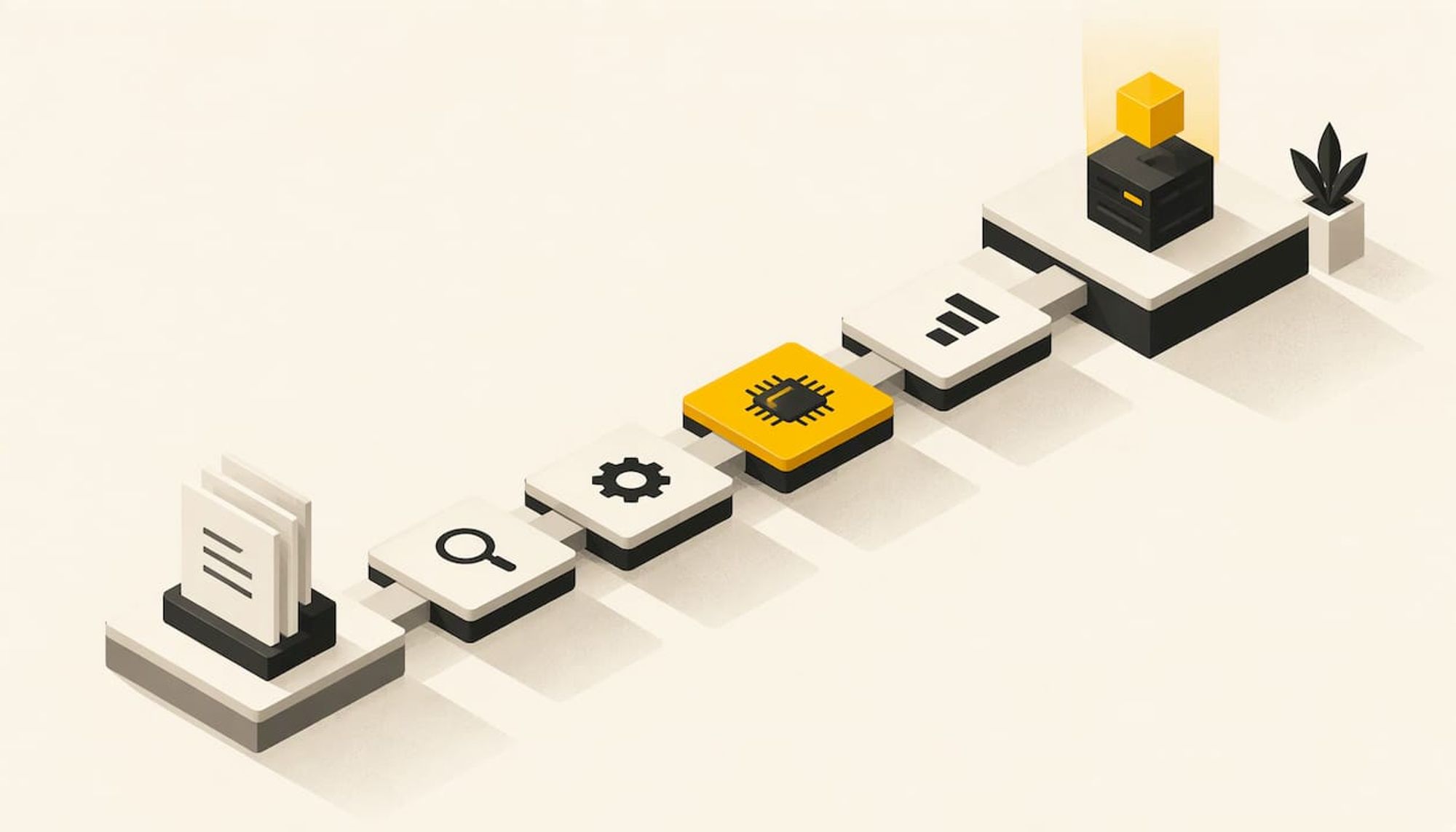
AI implementation services take you from "we should use AI" to a working system inside your daily workflow. That means choosing one use case, building or configuring the tool, connecting it to your existing systems, training your people and checking that it pays off. If you run a small business, holiday let or independent shop in Ireland, the best place to start is one repetitive task, built around how you already work.
This guide explains what the services cover, how a project runs, what to budget, which Irish and EU rules apply and how to measure the result.
What AI implementation services include
Buying an AI tool and implementing AI are different things. A subscription gives you software. Implementation gives you a system that your team actually uses, connected to your data, with someone responsible for it.
A typical project, as Microsoft describes it, covers these parts:
- readiness checks and use-case selection
- data preparation
- architecture and tool choice
- configuration or development
- integration with the systems you already use
- testing and deployment
- employee training
- governance, monitoring and improvement after launch
Large enterprises need all of these at scale. A small business needs the same logic in a smaller package. You still choose a task, connect the tool to where the information lives, test it with real cases, and teach whoever will use it.
Providers also come in different types: strategy consultancies, development shops that build models from scratch, and integrators of existing platforms. A fourth type works alongside the owner and builds a tool for one specific workflow. For an independent business, that last type is often the best fit, because the work is shaped by the way you operate rather than by a generic template.
What implementation looks like for an Irish small business
You do not need a data science team to benefit. ThinkBusiness lists the tasks where Irish SMEs are using AI: email replies, quotations, follow-ups, complaint responses, meeting summaries, supplier comparisons, competitor analysis, market research, social content, newsletters and product descriptions.
A second phase is where assistants draw on a company's own documents, tone and processes for onboarding, sales and client communication. That is where implementation work matters most. A generic chatbot knows nothing about your cancellation policy or your supplier terms. A tool built around your workflow does.
Two examples from the kinds of businesses I work with:
- Holiday lets and Airbnb hosts. Guests book through a direct booking website, check in without a key handover, and receive a concierge guide with house rules and local tips. Repetitive messages stop eating your evenings.
- Independent retailers. A tool compares supplier prices so you do not check each catalogue by hand before reordering — see our guide to using AI in a retail business for how that looks in practice.
The stages of a project
Whatever the size, a sound project follows the same order. Ireland's enterprise study notes that moving beyond pilots into everyday use can require data preparation, integration, workflow redesign, staff capacity, legal and cybersecurity reviews and ongoing operation. Here is how that plays out in practice.
- Observe the workflow. Before choosing any technology, watch how the task is done today. Where do messages pile up? Which steps repeat? Which spreadsheet is the real system of record?
- Pick one use case. Choose the task where AI saves the most time with the least complexity.
- Set a baseline. Record how long the task takes now, how many errors occur and what it costs. Without this you cannot prove improvement later.
- Prepare the data. Gather the documents, price lists, house rules or booking records the tool will use, and tidy them.
- Build or configure. Create the tool and connect it to your booking calendar, email, accounting package or supplier files.
- Pilot with limited use. Microsoft recommends piloting with a small group first. Run real cases, fix what breaks, then widen use.
- Train and hand over. The people using the tool should understand it in plain language and be able to manage it without a technical background.
- Monitor and improve. Review results, adjust and decide whether to expand to the next task.
A useful point from the same Microsoft guide: when implementation fails, the cause is usually weak data, infrastructure, skills or adoption, rarely the AI model itself. That is why the data and training steps deserve as much attention as the build itself.
How to choose your first use case
Microsoft suggests ranking candidate use cases by value and effort and starting with one that is high in value and low in complexity. For a small business, a quick scoring pass works well. Ask of each task:
- Is it repetitive, done the same way many times a week?
- Is the information it needs available in digital form?
- Does it follow patterns, such as the same guest questions or the same supplier lists?
- Would a simple, non-AI fix do the job? If so, use that. If not, AI is a real candidate.
- What does it cost you now in hours, errors or missed bookings?
A similar AI-readiness scorecard — scoring repetitiveness, data intensity, pattern recognition, resource impact and the cost of inaction — supports a decision to proceed, pivot or pause. A pause is a legitimate result when the task or data is not ready.
| Business | Task | Why it works as a first project |
|---|---|---|
| Holiday let | Guest check-in and a concierge guide | Same questions every stay, clear rules, easy to measure in hours saved |
| Holiday let | Direct booking website | Reduces reliance on platform fees and handles enquiries consistently |
| Independent retailer | Supplier price comparison | Repeated reordering, structured price lists, direct effect on margin |
What AI implementation costs in Ireland
The honest answer is that cost depends on scope, and the main mistake is counting only the software. Ireland's Department of Enterprise, Tourism and Employment says implementation funding should recognise data and integration, technical infrastructure and assurance, organisational implementation, and deployment and early operation, not just licences or proofs of concept.
For a small business, the practical way to control cost is to keep the first project narrow and pay for the work by the hour, so you see progress at each step. Projects such as a supplier price comparison tool or a concierge guide are scoped with you and charged from around €120 per hour, so you see progress at each step.
Funding and support
It is worth checking public support before you commit. Enterprise Ireland announced that ENTIRE 2.0, the second phase of the European Digital Innovation Hub programme, launched in September 2026. The four Irish hubs secured €23 million for 2026 to 2029, and eligible enterprises can access its services at up to a 100% discount through the De Minimis State Aid process. Eligibility and available services change, so confirm the current terms on the official page before you plan around it.
Privacy, security and the EU AI Act
A responsible implementation deals with the rules at the start, not after launch. Three layers matter for Irish businesses.
- GDPR. Whenever AI processes personal data, such as guest names, booking details or customer emails, GDPR applies. Ireland's Regulation of Artificial Intelligence Act 2026 gives Irish statutory meaning to the EU AI Regulation and the GDPR, including the roles of controller and personal-data processing.
- The EU AI Act. Any Irish company that develops, sells or uses AI, even internally, must comply. The Department's suggested steps are to map your AI use, determine the risk category, check for prohibited practices, put governance and oversight in place, keep transparency and documentation, build AI literacy, work with trusted suppliers and monitor updates. The Act entered into force on 1 August 2024, takes a risk-based approach and most provisions apply from 2 August 2026.
What this means day to day: AI-literacy obligations apply to businesses using AI, and customer-facing chatbots must disclose that users are talking to a machine. A guest-facing concierge assistant should say so clearly. Higher-risk uses, such as recruitment and CV screening, credit scoring, education and essential services, need earlier compliance preparation — most hospitality and retail workflows sit outside these. Penalties are real: up to €35 million or 7% of worldwide turnover for prohibited practices, and up to €15 million or 3% for breaches of other obligations.
On security, Ireland's NCSC calls for governance and AI usage policies as immediate priorities, along with continuous monitoring and reassessment of controls — sound practice for a private business too. Write a short usage policy, decide who can see what, and review it as the tool changes. For legal questions about your specific use, speak to a solicitor who works with data protection and the AI Act.
Measuring whether it worked
The baseline you set in the first stage now pays off. Compare before and after on the things your business cares about: hours spent on admin, response time to guest enquiries, direct bookings, reorder cost, errors.
The sensible way to measure AI return is through business outcomes — revenue growth, cost reduction, productivity gains, faster cycle times and customer satisfaction — set against the total cost of implementation. In Ireland, 53% of respondents in one 2026 survey confirmed measurable productivity gains from AI agents, while 38% said this translated into tangible cost savings. Hours freed only pay off when you use them for something: more bookings, better customer service, or simply a lighter week.
Review at 30 and 90 days, then decide: expand, adjust or stop.
Perspective
I have started and run seven businesses, and I have sat on the receiving end of plenty of technology that looked good in a demo and died in a drawer. That experience shapes how I implement AI.
I build everything custom, and I start by watching the real workflow, in person where I can. A host's check-in routine and a shop's reordering habits are different problems, and neither is solved by a generic subscription.
I also build with the owner, not for them. The tool is explained in plain English and designed so you can manage it without technical expertise. If you cannot run it on a Tuesday when I am not there, it is not finished.
My advice is to be ambitious about the outcome and modest about the first step. Pick one repetitive task, measure it, build it well and let the result decide what comes next.
Work with us on your first AI build
If you run a holiday let, an independent shop or a small business in Ireland, I build custom AI-powered tools around your actual workflow: direct booking websites, guest check-in, concierge guides and supplier price comparison. Projects are charged by the hour, from €120, and you work directly with me.
If you want the bootstrapping thinking behind this approach, that's in How to Start a Business with Almost No Money.
FAQ
What are AI implementation services?
They are the work of turning an AI idea or purchased tool into a working system in your business. That includes choosing the use case, preparing data, building or configuring the tool, integrating it, testing, training your people and monitoring results afterwards.
How long does an AI implementation project take?
It depends on scope, so no single figure fits every business. A narrow first project, such as guest check-in or a supplier price comparison, is far quicker than a company-wide rollout. Agree a defined first stage, review the results, then decide whether to extend.
Do I need technical skills to run an AI tool after it is built?
Not if it is designed well. Our tools are built to be managed without technical expertise, and we explain how they work in plain English so you stay in control after handover.
Does the EU AI Act apply to a small business in Ireland?
Yes, if you use AI, even internally. The Department of Enterprise, Tourism and Employment says any Irish company that develops, sells or uses AI must comply. For most small-business tools that means mapping your use, building AI literacy and being transparent when customers talk to a chatbot.
How do I know if the project paid off?
Record a baseline before the build, then compare hours, costs, bookings or errors afterwards. Judge it on business outcomes rather than on how often the tool is used.

Leave a comment.
Enter your email and your comment — comments are moderated before anything is published.
Comments are moderated. Your email is never published.
Thanks — your comment is in for review.
No comments yet — be the first.