
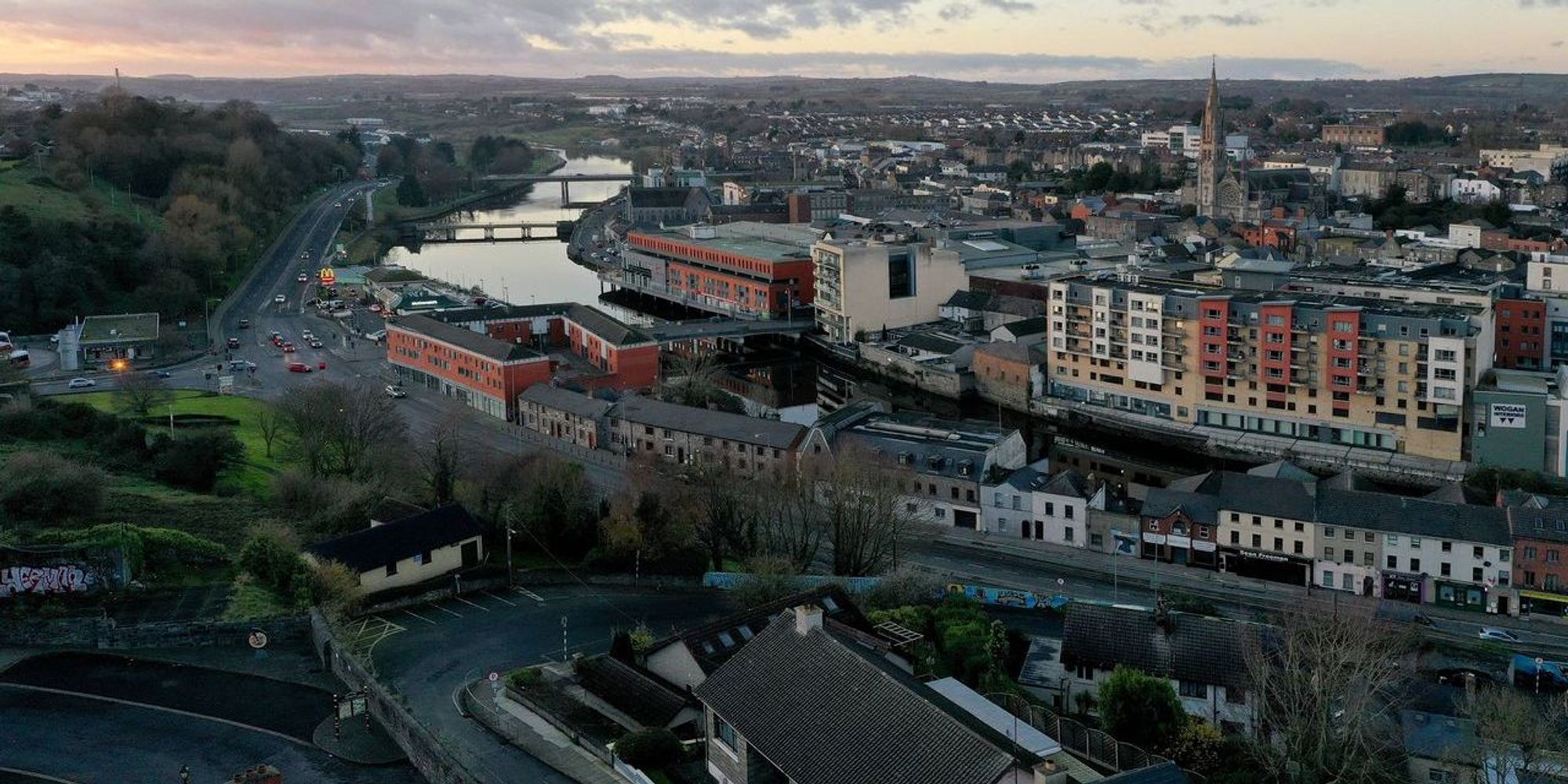
A personal opinion piece by Andrine Mendez, Drogheda resident and Events & Community Lead, Drogheda City Now
Quick summary: The Irish Government published its Local Democracy Taskforce – Government Implementation Plan in July 2026, an 8-objective, 79-action roadmap for local government reform running to 2029. Despite Drogheda being Ireland's largest town and one of its fastest-growing urban areas, split across Louth and Meath county councils, the word "Drogheda" does not appear anywhere in the document. This piece explains what the report actually contains, why its Municipal Councils model would double Drogheda's governance fracture rather than fix it, and why that matters for every Drogheda taxpayer and commuter.
I sat down last week with a 44-page PDF called the Local Democracy Taskforce – Government Implementation Plan. Two government ministers, a foreword each, eight "key objectives," a timeline running all the way out to 2029. I read the whole thing looking for one word.
Drogheda.
It isn't there. Not once. Not in the introduction, not in the objectives, not in the 79 numbered actions, not in a single footnote. A document about the future of local government in this country — published in July 2026, while Drogheda is officially recognised as Ireland's largest town and one of the fastest-growing urban areas in the State — doesn't mention us at all.
I want to tell you why that made me angry, and then I want to tell you why it should make you angry too, even if you've never been to a DCN event or signed up as a member or thought twice about "city status" as anything more than a slogan on a poster.
What is the Local Democracy Taskforce report, in plain English?
Strip away the civil-service language and the plan is simple. Every county in Ireland is going to get slightly stronger "Municipal Councils" — a rebrand and modest upgrade of what currently exists as Municipal Districts. They'll get a bit more budget say, a bit more of a formal voice, a "Town Priority Programme" here and there. Real, if modest, improvements — for a normal town, sitting inside a normal county, with a normal-sized population.
Drogheda is not that town.
We are split almost down the middle between two counties. Roughly 81% of us fall under Louth County Council, and the rest under Meath. Two separate administrations, two separate budget cycles, two separate sets of councillors who will now — under this very plan — get two separate "Municipal Councils," reporting to two separate county headquarters, neither of which is in Drogheda.
Read that again. The Government's flagship plan for strengthening local voice, applied to Drogheda, would give us two weaker half-voices instead of one strong one. It doesn't heal the fracture. It doubles it.
And the maddening part is that the report's own stated principle — "subsidiarity," decisions made as close as possible to the people they affect — is the exact principle that Drogheda's split administration violates every single day. The Taskforce wrote 91 pages in the original report and never once turned that principle on ourselves.
Where does Drogheda's tax money actually go?
Here's what actually keeps me up at night about this, and it's not really about council chambers or committee structures. It's about money.
Drogheda is a commuter town. Every morning, a huge share of this town gets on the M1, the train, the bus, and goes to Dublin to work. We are, by any honest measure, one of the most significant sources of personal income tax feeding into the national exchequer of any urban area our size in the country — because we house tens of thousands of PAYE workers who commute out, earn well, and pay accordingly, while living here.
That tax doesn't come back to us in proportion to what we put in. It goes to a national pot, and Drogheda — a town without its own council, without its own dedicated budget line, without a single unified administration to lobby for it — has no direct mechanism to pull its fair share back down the M1. We are, in effect, subsidising infrastructure, services and investment everywhere except the town we actually live in. And the report I just read, the one that was supposed to fix exactly this kind of structural imbalance, doesn't even acknowledge that Drogheda's population has passed 50,000, let alone that we're paying our way like a small city and being governed like a parish.
That's not a technicality. That's my taxes, and yours, going out the door every month and not coming home.
Why does Drogheda city status matter to ordinary residents?
I know "city status" can sound abstract. Like a branding exercise. A word on a road sign.
It isn't. It's the difference between:
- A council that can plan Drogheda's roads, housing and schools as one growing town, instead of two half-plans stapled together across a county line.
- A budget that's actually ours, instead of a rounding error inside Louth's budget and a smaller rounding error inside Meath's.
- One planning authority that can say yes or no to what gets built here, instead of two, sometimes disagreeing with each other, while we wait.
- A single, loud, undeniable voice in Dublin instead of two quiet, easily-ignored ones.
Every single person who sits in M1 traffic, waits too long for a GP appointment, watches another derelict building sit untouched in the town centre, or wonders why a town our size still doesn't have the transport, healthcare or school capacity to match its population — this is why. Not bad luck. Structure. A structure this new report had every chance to fix and chose not to.
What has the reaction to the report been?
The Drogheda City Status Group — the group that's been fighting this fight for over a decade, long before I got involved — put out a statement this week that didn't hold back. Their Executive Chairperson, Sylvia McCann, called the report "a missed opportunity that leaves Drogheda split down the middle between Dundalk and Navan," and said plainly that duplicate bureaucracies and piecemeal infrastructure are holding back a town that should be a major regional economic hub by now. I won't repeat the whole statement here, but I'd urge you to read it. It's the sound of a community that has done the work — data, submissions, meetings with ministers — and been told, again, to wait.
At the same time, there's a genuinely hopeful thread running alongside all this frustration. The Local Government (Cities) Bill 2026, brought forward by Deputy Joanna Byrne, is moving through the Dáil right now and would finally remove the technical barrier that's kept Drogheda from being designated a city in the first place — the fact that we span more than one municipal district. That Bill is a genuine milestone, and it's exactly the kind of bold, specific fix this new Taskforce report should have been built around. Instead, the two pieces of government policy are moving on separate tracks, seemingly without anyone in Government sitting down and asking the obvious question: how do these two fit together?
That's the gap. Not "the Government is against us." Something more frustrating: nobody has actually been made to answer the question.
And organised pressure does work, even when it feels slow. It's worth remembering how DCSG's legal action already forced one council U-turn — proof that this fight isn't just letters and statements, it gets real results when people push.
What can Drogheda residents do about this?
I'm not asking you to be angry for the sake of it. I'm asking you to be angry for the right, specific reason: this town pays its way, this town has outgrown the box it's been squeezed into, and a 44-page plan for the future of local democracy in Ireland didn't think we were worth a single mention. If you want the fuller case laid out — the population figures, the economic argument, why this matters for every household here — read why Drogheda needs city status now.
Then join us. Drogheda City Now exists because city status doesn't happen by accident, and it doesn't happen because a government department eventually gets around to it. It happens because enough of us — residents, business owners, commuters, parents, the person stuck behind you on the M1 this morning — say clearly and loudly that we've noticed. That we've read the report. That we know exactly what's missing from it.
Drogheda isn't in this plan. Let's make sure that's not true of the next one.
— Andrine
Drogheda City Now (DCN) is a community-led, non-party-political membership movement campaigning for formal city status for Drogheda. Find out more and join at droghedacitynow.com.
Frequently asked questions
Does the Local Democracy Taskforce report mention Drogheda?
No. The July 2026 Local Democracy Taskforce – Government Implementation Plan does not mention Drogheda by name anywhere in its 44 pages, despite Drogheda being Ireland's largest town and one of its fastest-growing urban areas.
Why is Drogheda's governance split between two counties?
Drogheda straddles the Louth/Meath county boundary, with roughly 81% of the town under Louth County Council and the remainder under Meath County Council. This means Drogheda has no single local authority, council budget, or planning authority of its own.
Would the new Municipal Councils help Drogheda?
Not as currently designed. Because Drogheda sits in two counties, the Taskforce's Municipal Councils model would create two separate Municipal Councils for Drogheda — one under Louth, one under Meath — each with its own budget cycle and reporting line, rather than a single unified voice for the town.
How does the Local Government (Cities) Bill 2026 relate to this?
The Local Government (Cities) Bill 2026, introduced by Deputy Joanna Byrne, would remove the barrier that has prevented Drogheda from being designated a city because it spans more than one municipal district. It is progressing through the Dáil separately from the Taskforce report, and the two have not yet been reconciled.
What is Drogheda City Now?
Drogheda City Now (DCN) is a community-led, non-party-political membership movement campaigning for formal city status for Drogheda. Find out more at droghedacitynow.com.

Leave a comment.
Enter your email and your comment — comments are moderated before anything is published.
Comments are moderated. Your email is never published.
Thanks — your comment is in for review.
No comments yet — be the first.